Burg and Brock
Award badge icon
Top-Rated Injury Law Firm

According to the National Safety Council, in 2020, 805 workers died in falls, and 211,640 were injured badly enough to require days off of work. You may ask who is responsible for fall accidents? Well, a slip and fall lawyer can help you to figure it out!

Slip & Fall Defined

Slip & Fall is an injury which occurs when someone slips, trips or falls as a result of a dangerous or hazardous condition through the negligence of a property owner.

When an individual slips & falls on someone else’s property and is injured as a result of a dangerous condition on the property, the land owner or business proprietor may find himself legally responsible and may be liable for the injuries.
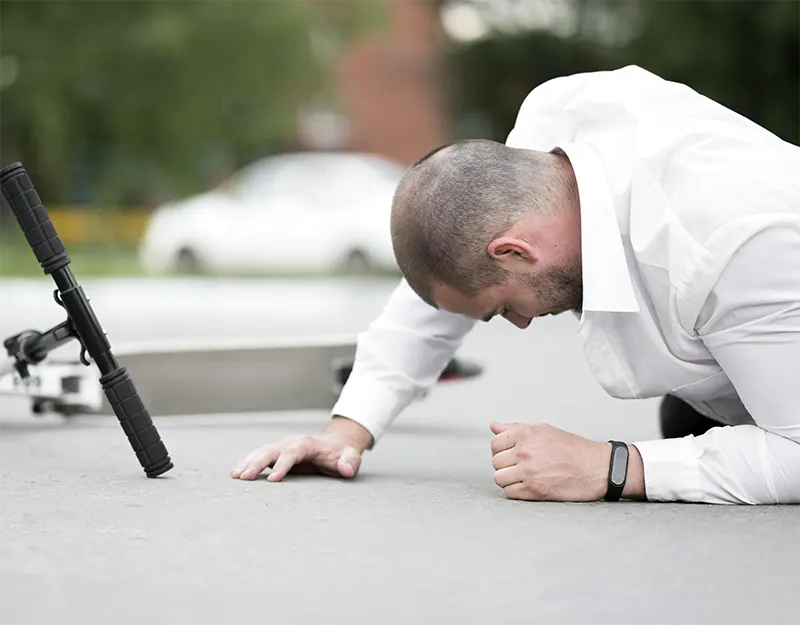
Property owners are responsible for injuries that occur as a result of a dangerous or hazardous condition on their property, which the owner knew about, or should have known about.
Adult male injured after a scooter fall — California slip and fall accident attorneys at Burg & Brock

Dangerous Or Hazardous Condition Defined

Dangerous & hazardous conditions may cause slips and falls due to accumulation of water, ice or snow, liquids, as well as abrupt changes in flooring, raised or cracked sidewalks, poor lighting, or a hidden hazard, such as a hidden ground hole.

A dangerous or hazardous condition may be apparent such as a broken step or railing in a staircase, or it may be hidden such as ground hole that is overgrown with grass.
A dangerous and hazardous condition may be permanent such as a 2 inch raised area of a sidewalk creating a change in elevation, or it may be a temporary spill of liquid in the aisle of a grocery store.
A dangerous and hazardous condition may even appear to be something normal but be in reality is a slippery situation.
Performer balancing on stairs in an abandoned building — premises liability hazard scene for California injury claims

Slip & Fall Example

The owner or manager of property can be liable to somebody injured on their property, but not under all circumstances. The owner or the manager of the property has to be negligent in the conduct of caring for or managing their property.

For example: Someone could fall down because a light burned out in a staircase; however, if the light had burned out just before the person got to that staircase and the person fell down, in this situation, the property owner or manager probably would not be liable because the owner or manager of the property did not cause the defect in the property, and the defect did not last long enough for the owner or manager of the property to know about the defect and fix it.

Trivial Defect

Another circumstance where a property owner might not be liable is if the defect is a trivial defect. If there is a defect in a raised sidewalk of 1/4 inch, where someone fell, then there is no liability. The sidewalk must be raised more than 2 inches, and it must be proved that the person injured, tripped on the raised sidewalk.

Property Owner’s Knowledge Of A Dangerous Or Hazardous Condition

In general, a property owner will be considered to have knowledge of a dangerous or hazardous condition if it is permanent in nature. When a dangerous or hazardous condition is permanent in nature, the owner would have known, or should have known, about the condition before the slip and fall accident occurs.

For example: If wet algae has accumulated on the sidewalk over a period of time due to leaking lawn sprinklers, it would have to be proved that the person responsible knew about, or should have known about the condition as it had been occurring over a period of time. An expert witness would be required to prove that algae overtime accumulates to this degree when water is leaking as in this situation.

Knowledge, Time, & Temporary Conditions

In the case of temporary conditions such as a liquid spill, the length of time that the condition existed before the incident occurred has legal significance. If the spill occurred just before the incident, then the property owner may not be liable for injury, since the owner could not have known about the spill (and would not have been able to do anything about it) before the slip and fall occurred.

For example: In a supermarket aisle another customer spills something immediately before the person falls down. In this case the owner of the store did not have enough time to find the spilled material and clean it up.
If the owner did not directly cause the spill and someone else caused the spill, the spill would had to have been on the property for a long enough period of time for the owner to be able to know about it and to be able to clean it up.

Knowledge, Time, & Permanent Or Reoccuring Conditions

Knowledge of dangerous or hazardous condition example:

If the spill was present for some period of time before the incident,
or occurs in an area subject to liquid spills, such as near the fresh flowers or fresh produce aisle in the supermarket where the produce or flowers are constantly automatically watered
is a recurring event -whenever the aisles are mopped the floor becomes slippery-then the owner may be liable, even if the owner did not know about the spill before it occurred.

Damages For Slip & Fall Injuries

This depends on the jurisdiction and the facts of your particular case (an attorney can help you with this). Depending on the jurisdiction and the facts of your particular case, generally, the following damages may be recoverable:

Medical bills and expenses incurred as a result of the incident
Lost income for time from work
Recovery of the fair value of any clothing damaged in the incident
Compensation for pain and suffering as a result of the incident
General damages

For further information see the related sections:

Premises Liability
Negligence
Businessman taking a call in an office setting — California slip and fall and premises liability attorneys at Burg & Brock

Slip And Fall Lawyer

The Law Offices of Burg & Brock have been handling personal injury and wrongful death cases exclusively since 1996. Cameron Brock, the firm’s founder, has built a reputation as a successful slip and fall lawyer in that time, accumulating a 99% success rate (with verdicts and settlements), and over $1 billion in damages on behalf of his clients. Though Brock and his associates have taken on major cases in the last two decades, they have always endeavored to offer their services even to people whose budgets would normally not permit them the opportunity to hire a high profile slip and fall lawyer. Because Burg & Brock operates on a contingency basis, you don’t get paid anything unless they come through for you.
The other issue that often daunts many people who are considering pursuing a lawsuit is the often exorbitant costs that accompany it. There are fees, costs for stenographers and private investigators, and the total price tag can easily reach the tens of thousands. That is why, when you are looking for the right slip and fall lawyer, you should consider the resources that a larger, more established law firm like Burg & Brock can provide. A firm like this has the resources to advance the cost of a suit, enabling you to hire the very best without worrying about your budget. Frankly, the only thing you should be worried about is getting the justice you deserve. Let the experienced hands at Burg & Brock take care of the rest.

Related Practice Areas & Locations

Slip-and-fall and trip-and-fall claims live in premises liability. Below are related pages and city-specific intake for Los Angeles County.

Talk to one of our attorneys: Cameron Yadidi Brock  ·  Artin Fiterz, Esq.  ·  Greg Diarian  ·  Craig D. Rackohn  ·  Lena G. Karaminassian  ·  Isaac Radnia

Frequently Asked Questions

What does a slip and fall lawyer need to prove?

The property owner had a dangerous condition (wet floor, broken stair, etc.), knew or should have known about it, and failed to fix or warn about it within a reasonable time. The duty owed depends on whether you were an invitee, licensee, or trespasser under California premises liability law.

How much is a slip and fall settlement worth in California?

Minor injuries with no surgery settle $15,000 to $40,000. Cases with surgery (knee, shoulder, spine) run $75,000 to $250,000. Cases with permanent disability or significant scarring exceed $500,000. Burg & Brock handles complex slip and fall cases with seven-figure recoveries when liability and damages are clear.

How long do I have to file a slip and fall claim in California?

Two years from the fall under Code of Civil Procedure section 335.1. Claims against a government entity (city sidewalk, public building) require a tort claim notice within six months under Government Code section 911.2. Property owners destroy surveillance footage within 30 to 90 days, so act fast.

What if I was partly at fault for my fall?

California is a pure comparative negligence state. Your damages are reduced by your percentage of fault but you can still recover. If you were 30% at fault for not watching where you walked, you recover 70% of your damages.

What if the spill was just put there before my fall?

This is the constructive notice question. The property owner must have had enough time to discover the hazard. Liability hinges on store policies for floor inspection (typical retail standard is 15 to 30 minute walks). If the spill was less than 5 minutes old, liability is harder to prove.

Can I sue an apartment landlord for a slip and fall?

Yes for common areas (hallways, parking lots, stairs) and for hazards the landlord knew or should have known about in your unit. The implied warranty of habitability under Civil Code section 1941.1 and Green v. Superior Court support tenant claims.

What evidence should I preserve after a slip and fall?

Photos of the hazard before it is cleaned up, the shoes you were wearing, names of witnesses, the incident report from the store manager, and your medical records. Surveillance footage is critical: send a litigation hold within 48 hours.

What damages can I recover after a slip and fall?

Medical bills, lost wages, lost earning capacity, pain and suffering, and any permanent impairment. Slip and fall hip fractures in elderly clients often trigger long-term care costs that drive case value into the high six and seven figures.

What if I fell on a government property like a sidewalk?

Public entities have specific defenses under the Tort Claims Act. The dangerous condition must have been more than just trivial (Government Code section 830.2). A government tort claim notice is required within six months of the fall. Burg & Brock has experience with public-entity premises cases.

Should I give a recorded statement to the store's insurance?

No. The adjuster will use it to undermine your claim or argue comparative fault. Politely decline and refer them to your attorney. You have no legal duty to give a recorded statement to the store's insurance company.